
Portable EV chargers don’t plug into the wall the same way everywhere. The wall-side outlet you have on site decides what plug you need, how stable the connection is, and how practical the setup will be for long sessions.
If you already know your outlet type, go straight to the Plug index table. If not, start with the setup sections below.
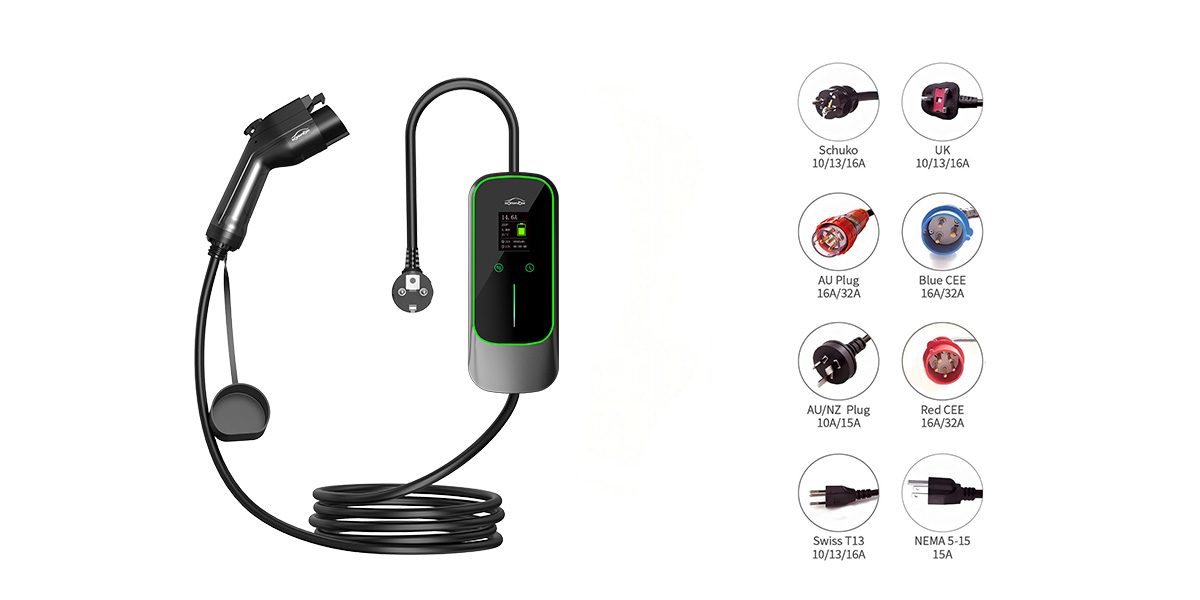
Use this table to match your situation to the right page.
|
Where you are charging |
What you’ll likely see |
Best-fit approach |
What to confirm |
Best next article |
|
North America garage / workshop |
NEMA outlet (higher-capacity) |
Use a dedicated outlet path |
Outlet fit + dedicated circuit |
NEMA 14-50 guide / NEMA 6-50 vs 14-50 |
|
Industrial site with single-phase access |
IEC 60309 Blue |
Standardize on site-ready plugs |
Rating on the socket (16A/32A) |
IEC 60309 Blue 16A vs 32A |
|
Industrial site with three-phase access |
IEC 60309 Red |
Confirm configuration before selecting |
Color + rating label + socket layout |
IEC 60309 Red 3-phase |
|
EU household sockets |
Schuko (Type E/F) |
Temporary use, conservative approach |
Socket fit + session length |
Schuko checks |
|
Considering adapters or extension cords |
Mixed |
Use clear limits, avoid stacking |
Connection tightness + heat at ends |
Safety limits page |
|
UK household sockets |
Type G |
Temporary use, conservative approach |
Socket fit + session length |
UK Type G guide |
In North America, portable EV chargers often plug into garage or workshop outlets. The main risk is the connection point: a worn or loose receptacle can heat up during long sessions, even if the circuit looks capable.
Start with the NEMA 14-50 page, then use the NEMA 6-50 vs 14-50 comparison if you’re choosing between the two.
IEC 60309 sockets are common on worksites and depots because they’re easier to standardize. Before selecting a plug, confirm what’s on site (blue vs red and the rating label) so you don’t arrive with the wrong configuration.
Use the IEC 60309 Blue page first, and switch to the Red 3-phase page when the site provides three-phase sockets.
Household wall sockets are best for occasional or travel charging. If sessions are long or frequent, the safest move is usually upgrading to a dedicated outlet or an industrial socket rather than relying on the same wall socket every day.
Start with the Schuko (Type E/F) page in most of Europe, or the Type G page if you’re in the UK.
Adapters and extension cords add extra contact points, which increases the chance of looseness and heat at the ends. Treat them as temporary and follow clear stop conditions if the connection feels loose or warms up.
Read the safety limits page before using any adapter or extension cord as a workaround.
A plug kit works best when it matches real use, not every plug in the world. Start with the top environments you need to support. For many projects that’s a mix of home/garage charging, site or fleet use, and occasional travel or temporary charging.
The goal is to avoid last-minute workarounds. Fewer adapters, fewer unknown outlets, and fewer surprises mid-charge. When charging becomes frequent and long, it usually makes sense to move away from household sockets and toward dedicated outlets or industrial sockets.
Minimum info to match the right plug kit:
Clear socket photo (show the face and any label)
Breaker rating (panel label is fine)
Dedicated vs shared circuit
Indoor/outdoor exposure
Typical session length
Can I use a plug adapter for EV charging?
Yes, but treat it as a temporary workaround. Avoid stacking adapters, and stop if the connection feels loose or the plug end gets warm. For frequent long sessions, it’s usually better to match the correct plug to the socket instead of relying on adapters.
Is an extension cord OK for a portable EV charger?
Only if you have no better option, and only for short-term use. The main risks are heat at the plug ends and a loose fit over long sessions. If you notice warmth, discoloration, or a soft plug fit, stop and switch to a closer outlet or a dedicated setup.
What should I confirm before choosing a plug for my portable EV charger?
Start with a clear photo of the socket and any label, then confirm breaker rating, whether the circuit is dedicated, and whether charging will be indoors or outdoors. If sessions are long and frequent, plan for a more stable outlet type rather than “making it work” each time.
Which is better for repeatable setups: household sockets or industrial sockets?
For repeatable charging on sites and fleets, industrial sockets are usually easier to standardize and more consistent. Household sockets are more about convenience and temporary use. If you expect regular long sessions, prioritize a setup that reduces unknowns at the connection point.
Related pages:


Address : 538 Fangqiao Road, SlP-Xiangcheng Cooperative Zone, Xiangcheng, Suzhou, China
 Contact Us


 English


 IPv6 network supported
