
If you’re unsure whether a CEE blue socket is 16A or 32A, don’t guess. The rating changes what current you can safely set and whether charging stays stable over time. Here’s a simple way to identify it, set current conservatively for the first session, and avoid the most common failure modes.
In everyday use, people often call these blue industrial sockets CEE blue. The technical standard name is IEC 60309. Either way, what matters on site is the current rating on the socket and whether the connection stays solid under a long, steady load.
CEE blue shows up where power was built for tools, temporary events, or fleet operations. You’ll see it in workshops, loading areas, maintenance bays, and outdoor service points. The socket may look “industrial,” but the circuit behind it may still be shared, repurposed, or exposed to weather and wear.
This article stays focused on one task: tell 16A from 32A, then translate that into a sensible current setting and a stable first-use routine.
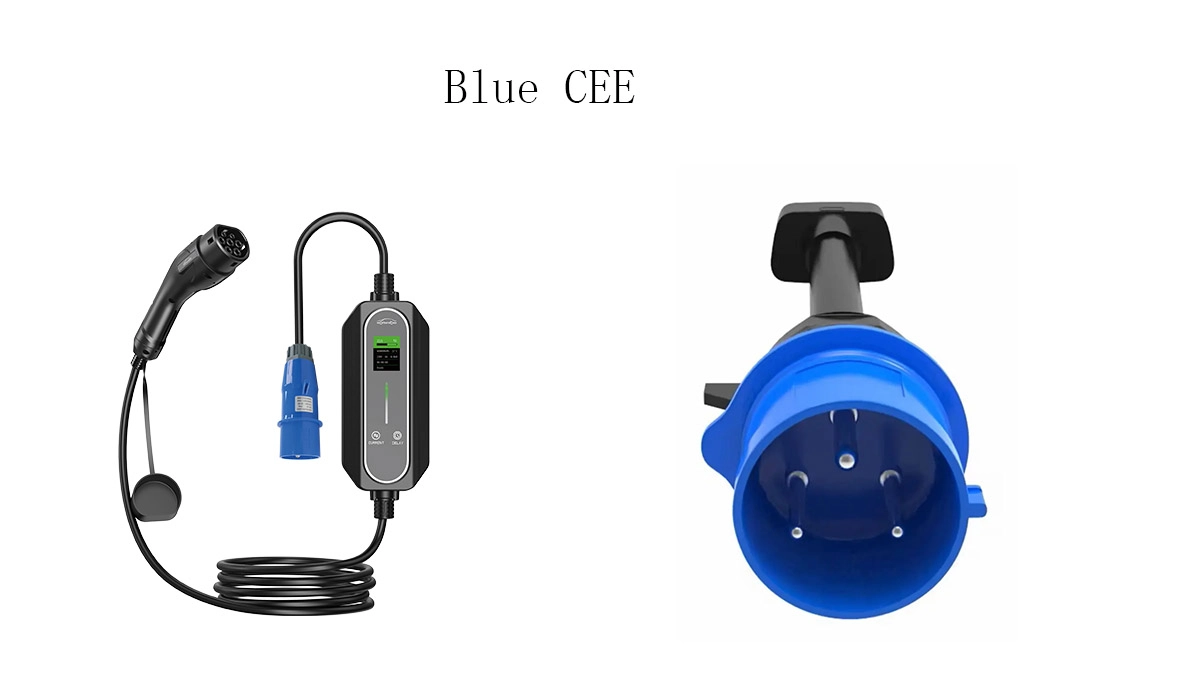
Start by looking for the answer that is already written down. The socket face, a nearby label, or the breaker panel description often states the current rating. If you can confirm 16A or 32A on site, that beats any photo-based guessing.
If the label is missing, use the practical cues that matter most in the real world.
A 32A CEE blue setup is usually visibly larger than a 16A one. Also, a 32A plug should not seat cleanly into a 16A socket. If the plug feels forced, won’t insert fully, or wobbles after insertion, treat the rating as uncertain and don’t plan a long charging session there.
One more sanity check: this page is about blue single-phase sockets. If what you’re looking at is red, has a different pin layout, or clearly looks like a three-phase industrial outlet, stop and confirm the outlet type before you set current.
The difference is not about which socket is “better.” It’s about what current you can safely set and how sensitive the setup is to small connection problems.
A 16A outlet often maps to a conservative charging routine. It’s a common choice when you’re not sure about the circuit, you’re outdoors, or you’re treating the location as a temporary top-up point.
A 32A outlet can support a higher current setting, which usually means higher charging power. But higher current also makes weak contact points show up faster. A slightly loose receptacle, a plug that doesn’t seat firmly, or a cable that pulls sideways can turn into heat, throttling, or a shutdown during a long session.
As a rough reference, single-phase 16A is around 3.7 kW and 32A around 7.4 kW, depending on voltage and your current setting.
The rule that keeps you out of trouble is simple: don’t set current based on what you wish you could draw. Set it based on the outlet rating and what the site can repeatedly deliver.
On an unfamiliar outlet, don’t start at the maximum you hope to use long-term. Start conservatively, then come back after 15–20 minutes and check again. Most real problems don’t show up in the first minute. They show up after the contact point has had time to warm.
If the plug end feels warm, if the plug fit feels loose, or if the socket faceplate moves when you touch the plug, treat that as a fix-first signal. Don’t push through by turning the current down and hoping the situation disappears.
For long sessions, EV charging is typically treated as a continuous load. That’s another reason the “it worked once” test is not enough. You want repeatability, not a lucky first run.
You don’t need a full electrical survey. You just need enough information to avoid the two most common failure modes: shared circuits and weak contact points.
· A clear photo of the socket face and any rating label you can find
· Whether the circuit is dedicated or shared with other loads
· Indoor vs outdoor exposure and how long you expect to charge
· Your charger’s current setting options (what you can actually set, not what you hope to pull)
If any of these are unknown, your default should be more conservative.
When a session trips mid-charge, shared load is usually the first thing to suspect. The circuit may also feed lights, heaters, compressors, or tools. Charging can look stable at the beginning, then fail when another load turns on. That pattern is common at worksites and depots, even when the socket itself looks “industrial.”
Heat at the plug end is often about contact quality. A worn socket, weak contact tension, or a plug that doesn’t seat firmly increases contact resistance. Resistance becomes heat, and heat triggers protective behavior. You may see the charger or vehicle reduce current, or the system may stop charging entirely.
Throttling that appears after a period of normal charging is especially consistent with contact-point heating. It’s also why the 15–20 minute check is so effective: it catches the early warning signs before you commit to hours of charging.
Use this table to decide what to check first on site. It is not a claim that one outlet type is always “better.”
|
Item |
CEE blue 16A (typical reality) |
CEE blue 32A (typical reality) |
|
What to look for first |
Rating label, plug fit, shared loads |
Rating label, plug fit, contact quality |
|
Typical site |
Temporary site power, event power, mixed-use bays |
Dedicated depot points, workshop bays, heavier-duty circuits |
|
A sensible first-use setting |
Conservative, confirm stability first |
Conservative first session, then step up if stable |
|
Most common problem |
Shared circuit trips |
Contact heating, throttling after warm-up |
If you see any of the signals below, treat it as a fix-first situation before you chase higher current.
If you can’t confirm the installation condition, ask a licensed electrician to verify the circuit and receptacle before relying on it for long sessions.
· Plug won’t seat fully or wobbles after insertion
· Faceplate moves when the cable shifts
· Plug end is noticeably warm during the first 15–20 minutes
· Random trips mid-session that correlate with other site activity
· Charging starts strong, then steps down or cuts out without a clear reason
Is CEE blue the same thing as IEC 60309 blue?
In everyday use, “CEE blue” is a common name for the blue IEC 60309 single-phase industrial plug and socket family. On site, the rating label and a solid plug fit matter more than the label you use. For charging, treat the rating label as the source of truth.
Can I use a 32A portable charger on a 16A CEE blue socket?
Only if you can limit current to the outlet rating and the connection is solid. If the plug fit is imperfect, the socket is worn, or the circuit is shared and unpredictable, treat it as a temporary top-up point at a conservative setting, not a long overnight session.
Why does it look fine at first and fail later?
Because heat and shared loads take time to show up. A weak contact point warms gradually, and a shared circuit may only trip once other equipment turns on.
If you charge across multiple locations, aim for fewer contact points and the same first-use routine every time. That combination prevents most “it worked yesterday” surprises. Workersbee Portable EV Charger setups can be configured with interchangeable wall-side plugs, which helps keep the hardware consistent while you adapt to different site sockets.

Address : 538 Fangqiao Road, SlP-Xiangcheng Cooperative Zone, Xiangcheng, Suzhou, China
 Contact Us


 English


 IPv6 network supported