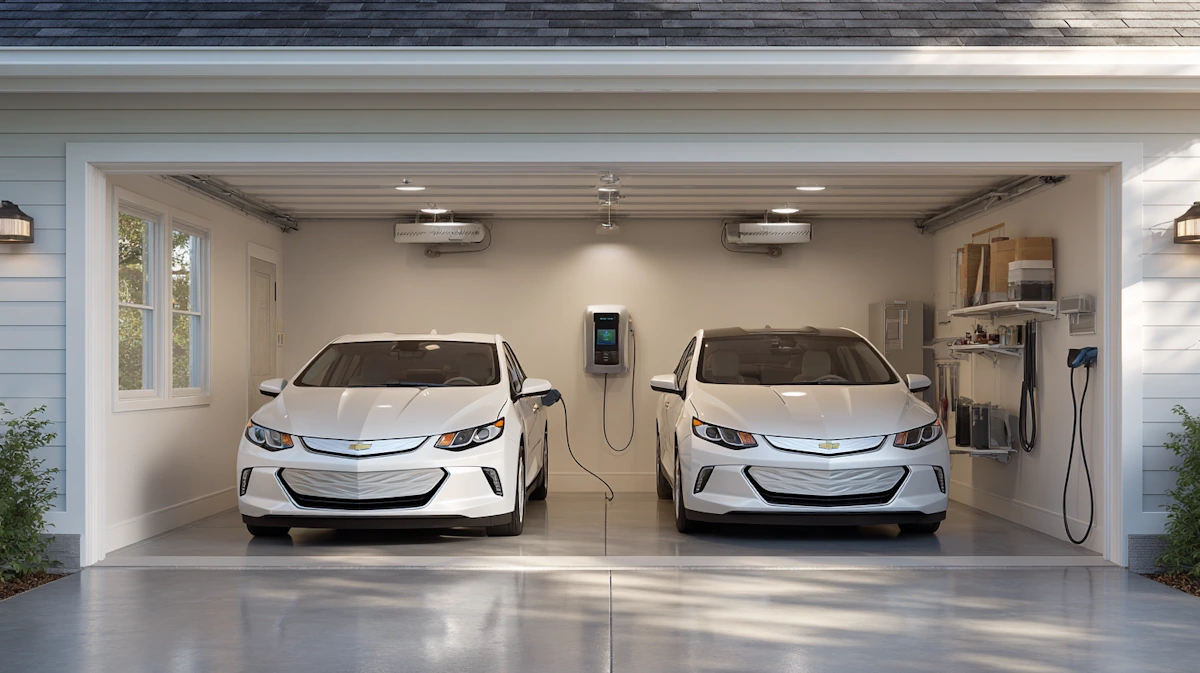
 Two EVs at Home: One Charger or Two?
Nov 18, 2025
Most households don’t need two wall chargers. The right setup depends on five things: daily miles for each car, how much evening time overlaps, spare panel capacity, whether you use time-of-use pricing or solar, and how much cable swapping you can accept.
Decision ChecklistScore each item 0–2 (0 = low pressure, 2 = high). Add them up.
Factor
0
1
2
Daily miles per car
< 25 mi
25–60 mi
> 60 mi
Evening overlap
Rare
Sometimes
Most nights
Spare panel capacity
≥ 60 A available
40–50 A
< 40 A
TOU/solar window
Not using
Nice to have
Must finish both in cheap window
Willingness to rotate
Happy to rotate
Can rotate weekly
Prefer set-and-forget
Result guide:0–3 one Level 2 with rotation; 4–6 dual-port or load-sharing on one circuit; 7–10 two dedicated Level 2 circuits.
Quick Math• Energy needed (kWh) ≈ daily miles × 0.30• Charge time (hours) ≈ energy needed ÷ 7.2 kW (typical 40 A @ 240 V L2)
Examples• 35 mi/day → ~10.5 kWh → ~1.5 h. Two cars can rotate easily overnight.• 70 mi/day → ~21 kWh → ~3 h. Two cars may benefit from dual-port/load-sharing or two circuits to finish within a short off-peak window.
Charging Options for Two EVs
A) One Level 2, rotate by scheduleWhen it fits: moderate miles, staggered arrivals, or anyone okay moving a plug once.Pros: low cost; often no panel upgrade; simple to maintain.Trade-offs: needs a routine; late arrivals may wake up partially charged.
B) Dual-port or load-sharing on one circuitWhen it fits: limited panel capacity; both cars home at night; you want automation.Behavior: two connectors share one feeder; current splits between cars while both are charging; when one tapers or finishes, the other ramps up.Pros: set-and-forget; often avoids panel work.Trade-offs: peak rate per car is lower when both charge.
C) Two dedicated Level 2 circuitsWhen it fits: high miles on both cars; tight morning deadlines; short off-peak windows.Pros: fastest and most independent; easier to expand later.Trade-offs: highest install cost; possible panel upgrade.
Option Comparison
Criterion
Rotate One L2
Dual-Port / Load-Sharing
Two Dedicated L2s
Up-front cost
Low
Medium
High
Ready by morning (both cars)
Medium
Medium–High
High
Panel impact
Minimal
Minimal–Moderate
Moderate–High
Convenience
Moderate
High
Very High
Expandability
Low
Medium
High
Install complexity
Low
Medium
High
Cost and Install Factors
Factor
Low impact
Medium impact
High impact
Run length panel→charger
≤ 10 m
10–25 m
> 25 m
Walls and routing
Same-wall, single pass
One turn, short surface conduit
Multiple turns, attic/crawlspace work
Indoor/outdoor
Indoor, dry
Semi-covered carport
Fully outdoor, weatherproofing and trenching
Spare circuits
Empty slot available
Subpanel needed
Main service upgrade likely
Parking layout
Two cars nose-to-nose, short leads
Staggered bays, longer cable management
Separate bays, long conduit or second location
Electrical Capacity and CircuitsSpare capacity is how much continuous current your panel can safely add. Many homes can support one 40 A circuit for a Level 2 unit without upgrades. A second circuit may require a load calculation and, in some homes, a panel or service upgrade. Load-sharing products let two connectors live on one feeder and coordinate current as cars start and stop.
Single-Phase RealityYou don’t need three-phase to charge two cars. On single-phase, sharing splits available power; the right metric is whether each car reaches its target by departure time, not its peak kW at any instant.
When Two Chargers Make Sense• Both cars often exceed about 50–60 miles per day.• Evenings overlap and both must finish before early departures.• Off-peak tariff windows are short and you want two cars to complete within them.• Winter range loss or frequent road trips compress your overnight buffer.• You plan for growth: another EV, visitors, or faster onboard chargers.
When One Charger Is Enough• Typical days are under 40 miles per car.• Arrivals are staggered; one car sits most nights.• You can rotate once in the evening or a few times per week.• A 120 V cord covers occasional top-ups.• You prefer to defer panel upgrades.
Implementation Options• Dual-port EVSE on one circuit: two connectors, coordinated split, simple user experience.• Two same-brand units with cloud load-sharing: devices balance current on the same feeder.• Two independent circuits: clean performance for high-mileage pairs or tight schedules.Tip for flexible nights: in rotation scenarios, a Workersbee portable EV charger helps with temporary or overflow charging without changing fixed wiring.
TOU and Solar: Finish Both in the Cheap Window• Start both sessions near the off-peak opening.• Prioritize the early-departure car with a higher target or earlier start.• Expect slower rates while both are charging; once the first tapers or completes, the second ramps.• With rooftop solar, combine daytime charging for one car and overnight for the other to improve self-consumption.For fixed installations that see daily use, durable Workersbee EV connectors pair well with scheduled charging and load-sharing strategies.
Safety, Permits, and Installation• Confirm permit and inspection needs before work.• Match conductor size and breaker rating; respect continuous-load limits.• Use weather-appropriate enclosures and fittings outdoors; add drip loops.• Keep cables off walkways; add hooks or rests; avoid tight bends.• Label circuits and parking spots so rotation stays simple and safe.
FAQCan two EVs share one charger effectively?Yes, if miles are moderate or you can schedule. Load-sharing or dual-port hardware reduces hassle.
Do I need three-phase to charge two cars at once?No. Single-phase can support two cars with sharing or two circuits. Peak speed per car is lower than a single dedicated circuit.
Is a second charger worth it with TOU or solar?If your cheap window is short or you aim to maximize self-consumption, two connectors help both cars finish on time.
Panel capacity seems tight—what is the first step?Get an on-site load calculation and route assessment, then weigh sharing on one feeder versus a service upgrade.
Read More

 Solar Car Port for ev charging


 Contact Us


 English


 IPv6 network supported