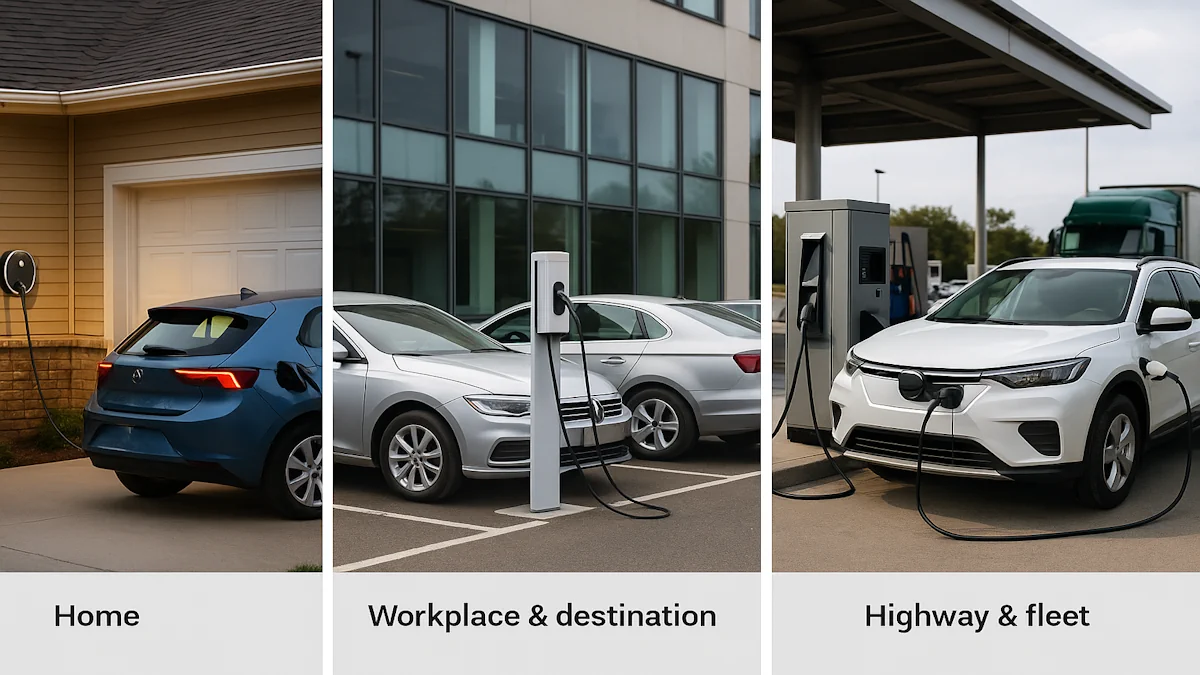
Home

Type 2 charging cable

  • Mode 1, 2, 3 and 4 EV Charging Explained: What Each One Is Used For Mode 1, 2, 3 and 4 EV Charging Explained: What Each One Is Used For
    Nov 21, 2025
    Most people talk about slow AC charging and fast DC charging. In the standards behind the scenes, the same ideas are described as Mode 1, Mode 2, Mode 3 and Mode 4. These modes describe how the car is connected to the grid, where the electronics sit, and how the system keeps people and buildings safe. A charging mode is not the plug shape and not the same thing as “Level 1 / Level 2” in North America. Mode describes the whole charging concept: AC or DC, which device controls current, how the car and station exchange signals, and what protection is in place. Once you know the four modes, it becomes easier to decide when a portable cable is enough, when a wallbox makes sense, and where DC fast charging is worth the investment.     The four charging modes Mode 1 – Simple cable to a household outlet, no control box, almost no communication. Largely outdated and not recommended for modern EVs. Mode 2 – Portable cable with a control and protection box in the middle. Uses existing sockets for occasional or backup charging. Mode 3 – Fixed AC wallbox or AC charging post with full control and protection. Used for regular AC charging at home, at work and in public car parks. Mode 4 – DC charging where the station houses the power electronics and sends DC through a dedicated connector. Used for fast and ultra-fast charging.     The table below lines up the four modes by supply type, power and typical locations: Mode Supply Typical power range Typical locations Recommended use Mode 1 AC Up to a few kW Legacy setups, early demonstration projects Not recommended for modern EVs Mode 2 AC Around 2–3 kW, sometimes higher Homes, small businesses, temporary parking Occasional or backup charging Mode 3 AC Roughly 3.7–22 kW and above Homes, workplaces, destination and public sites Daily and regular AC charging Mode 4 DC Roughly 50–350 kW for cars, higher for heavy vehicles Highway sites, fast hubs, depots Fast and ultra-fast charging     Mode 1: a legacy solution Mode 1 connects the vehicle straight to a standard socket with a basic cable.There is no control box in the cable and no dedicated electronics watching current or talking to the car. In this setup the EV pulls power through wiring and outlets that were never built for long high-load sessions. Sockets can overheat, wiring can be stressed, and the user has little warning until something smells hot or fails. Because of that, many countries restrict or discourage Mode 1 for modern EVs.You might still see it in old pilot projects or very small, low-power vehicles, but it is not a realistic choice for a new home installation or public site. When people plan infrastructure today, Mode 1 sits in the “history” box.   Mode 2: portable EV chargers Mode 2 is the portable EV charger many cars ship with. One end plugs into a household or industrial outlet.Halfway along the cable there is a box that contains control and protection electronics. From there the cable continues to the vehicle inlet. That box usually does three main things: Limits the maximum current to what the socket and wiring are rated for Watches temperature at the plug or inside the box and shuts down if things get too hot Sends basic signals so the car knows how much current it is allowed to draw   The concept is simple but useful. Drivers can use existing sockets without installing a wallbox. People who rent, move often or park in different locations gain flexibility. There are real limits: Power is capped by the outlet rating and by local rules Older buildings may have wiring that does not like hours of high current Weak sockets, loose contacts or tired extensions can overheat if used at full load   So Mode 2 is best treated as an occasional or backup tool.It works well for overnight top-ups when daily mileage is modest, for visiting friends and family, for holiday homes, and for mixed fleets where cars do not always return to the same bay. Portable chargers built for Mode 2 have to be tough. The box is dropped, kicked and thrown in trunks. Housings need impact resistance and sealing against dust and water. Cables are coiled and uncoiled often, so they need good flexibility in cold and heat. Plugs must manage heat at the rated current even when the outlet is not in perfect condition.   Mode 3: AC wallboxes and AC posts Mode 3 is the standard way to do regular AC charging.The EV connects to a dedicated AC wallbox or AC charging post that contains its own control electronics, protection devices and communication with the vehicle. The charger is fed from a dedicated circuit. In a home this might be a single-phase wallbox at 7 or 11 kW.In regions with three-phase supplies, workplaces and public car parks often offer up to 22 kW per outlet. Exact numbers depend on the building connection and local codes. The goal is a circuit sized and protected for long-duration EV charging.   For the user, Mode 3 usually means: A cable that lives on the wallbox or on the post instead of in the trunk Clear status lights or a screen, sometimes with access control and billing Less guesswork around whether the wiring can handle the load   On the vehicle side, most light-duty EVs use a Type 1 or Type 2 inlet for AC.On the station side there are two common layouts: Tethered units with a fixed cable and plug ready to grab Socketed units where the driver brings a separate Type 2 cable   Each choice has hardware consequences: Tethered cables are plugged in and out many times a day and stay outdoors in sun, rain and dust. Jackets, strain relief and the rear of the connector take a lot of mechanical stress. Socketed posts shift more wear to the user’s cable, which must have the right cross-section, flexibility and pull relief. Contact geometry, surface treatment and latch strength affect how long the hardware lasts before it becomes loose, noisy or unreliable.   When the components are well designed, Mode 3 looks boring in a good way: plug in, walk away, come back to a charged car and clean connectors. Poor designs show up later as hot plugs, moisture inside housings or broken latches.       Mode 4: DC fast charging Mode 4 is DC charging with the converter in the station instead of in the car.The station takes AC from the grid, turns it into DC at a voltage and current that suit the battery, and sends it through a dedicated DC connector. First-generation DC chargers for cars often delivered around 50 kW.Newer highway and city hubs now commonly run 150–350 kW on a single stall. Heavy vehicles such as buses and trucks can go higher when vehicles, cables and switchgear are designed for it. Compared with AC, the hardware sees different stresses: Currents are much higher than in typical home or workplace charging Even a small increase in contact resistance can push temperatures up The connector must lock firmly under load but still be easy to handle all day   Mode 4 uses connector families such as CCS and GB/T DC for light-duty vehicles, and newer high-current interfaces for heavy trucks and buses. Cooling is a core part of the design. Naturally cooled DC cables can carry substantial power, but at the top end of the fast-charging range many systems use liquid-cooled cables and handles.Coolant channels run close to the conductors and contact blocks and carry heat away so that the outside of the cable and grip stays at a level people accept. That has to be balanced against weight and stiffness so staff can plug and unplug connectors many times per shift without strain. Mode 4 fits places where vehicles stop briefly but need to take on a lot of energy: highway sites, city fast-charge hubs, logistics depots and bus depots.     How modes affect connectors and cables Each charging mode pushes the hardware in a different direction.   Mode 2Electronics sit inside the cable assembly. The control box housing needs good sealing and impact resistance. Cables are moved and coiled more than in fixed installations, so they need flexible jackets and proper bend protection. Plugs on both ends must cope with heat at full load, because household outlets are not always perfect.   Mode 3Connectors see high mating cycles and outdoor exposure. Contacts need shapes and coatings that support long life. Cable jackets face UV, rain and snow, plus occasional knocks from wheels or shoes. Strain relief at the back of the connector protects the conductors where bending is concentrated.   Mode 4High current and demanding duty cycles drive cross-section and contact layout. In liquid-cooled systems, coolant channels and seals share limited space with conductors and signal pins. The handle still has to sit well in the hand, and triggers and buttons must remain easy to use even when the whole assembly is heavier than an AC plug.   Because the stresses and use patterns differ so much, manufacturers usually develop separate product families for Mode 2, Mode 3 and Mode 4 instead of trying to stretch one design across all three.     Choosing modes for homes, sites and fleets The right mix of modes depends on where the cars are and how they are used.   For private homes, useful questions are: Is there a fixed parking space close to the electrical panel How far the car usually drives in a day How many EVs share the same supply Whether the wiring is modern and has spare capacity   Some common patterns: In a rented home with modest daily mileage and limited permission for new wiring, a good Mode 2 portable charger on a checked, modern outlet can be enough to start with. In a home with a fixed parking bay and higher mileage, a Mode 3 wallbox on a dedicated circuit is usually the more comfortable long-term solution. Many households keep a Mode 2 unit in the trunk as a backup, even after a wallbox is installed.     For workplaces and public sites, the questions shift to: What type of site it is: office, retail, hotel, mixed use, depot How long cars normally stay parked Whether drivers expect a full charge or just a useful top-up   Typical outcomes: Offices and destination car parks rely mainly on Mode 3 AC. Cars stay for hours, so moderate power per space works well. Retail sites often mix a few Mode 4 fast chargers close to the entrance with a row of Mode 3 posts further away. Highway locations and depots for buses and trucks lean heavily on Mode 4, with a smaller number of AC points for staff cars or long-stay parking.   Seen like this: Mode 2 fills gaps where fixed infrastructure is limited or still being planned Mode 3 becomes the backbone of day-to-day AC charging Mode 4 covers short stops with high energy demand     Q&A on charging modes What are the four EV charging modes? They are four concepts from international standards that describe how an EV connects to the grid. Mode 1 is a simple AC cable to a socket with no control box. Mode 2 adds a control and protection box in the cable. Mode 3 uses a dedicated AC charging station. Mode 4 uses a DC charging station with the power electronics in the station.   Do charging modes decide which connector type I need? Not on their own. Modes describe how the system is built and controlled. Connector types such as Type 2, CCS or GB/T describe the physical shape and pin layout. In practice certain connectors line up with certain modes – Type 2 with Mode 3, CCS with Mode 4 – but the two ideas are separate.   How do charging modes relate to Level 1, Level 2 and Level 3? Level 1, Level 2 and Level 3 are North American labels for power levels and supply arrangements. Modes 1–4 are global concepts about how the EV and the supply are connected and controlled. A Level 2 charger for home use, for example, will usually operate in Mode 3.   Are charging modes defined the same way in every region? The basic definitions come from international standards, so Mode 1–4 mean broadly the same around the world. What changes is how local rules allow or limit each mode, especially Mode 1 and higher-power Mode 2 on domestic circuits.   Can one EV use more than one mode? Yes. Most modern EVs can charge in several modes. The same car might use a Mode 2 portable charger at a relative’s house, a Mode 3 wallbox at home or at work, and Mode 4 DC fast charging on long trips. The vehicle inlet and onboard systems are designed to recognise and work with these different setups.
    Read More
  • What Is a Type 2 EV Connector? A Plain Guide to the 7-Pin AC Plug (2025) What Is a Type 2 EV Connector? A Plain Guide to the 7-Pin AC Plug (2025)
    Oct 20, 2025
    Type 2 is the 7-pin AC charging interface widely used across Europe and many nearby regions for home, workplace, and destination charging. This guide explains the Type 2 connector pinout, including L1, L2, L3, N, PE, CP, and PP, plus basic wiring reference notes, AC charging power levels, and the difference between Type 2 and CCS2.   For buyers, operators, and technical teams, the key point is simple: Type 2 is for AC charging, while CCS2 is used for DC fast charging. A reliable Type 2 connection depends not only on the plug shape, but also on correct pin functions, CP/PP signaling, cable rating, and the vehicle’s onboard charger limit.     Type 2 Connector Pinout: What the 7 Pins Do A Type 2 connector has seven contacts: L1, L2, L3, N, PE, CP, and PP. The power pins support single-phase or three-phase AC charging, while CP and PP help the vehicle and charging equipment confirm connection status, current limits, and safe charging behavior.   Pin Function What It Does L1 AC live phase 1 Supports single-phase or three-phase AC charging L2 AC live phase 2 Used for three-phase AC charging L3 AC live phase 3 Used for three-phase AC charging N Neutral Provides the neutral path for AC power PE Protective earth Provides grounding protection CP Control pilot Handles charging control, status signaling, and current limit communication PP Proximity pilot Helps detect plug connection and cable current rating   This 7-pin layout is the reason Type 2 can support both simple home AC charging and higher-power three-phase AC charging. The connector is not just a power interface. It also includes control and safety signals that help the charging equipment and the vehicle communicate before and during charging.       Type 2 Plug Wiring Reference and Signal Flow A Type 2 plug wiring reference is mainly used to understand how the seven contacts work together. L1, L2, L3, N, and PE handle the AC power path, while CP and PP handle control and detection signals.   In a typical AC charging process, the charging equipment first detects whether the connector is properly inserted. Then the vehicle and EVSE confirm available current through the control signal. Once the charging system confirms that the connection is safe, AC power can be supplied to the vehicle’s onboard charger.   This information is useful for connector selection, product comparison, technical communication, and specification review. It is not intended for unauthorized field wiring or cable assembly. Actual cable design, installation, repair, or modification should follow local electrical regulations and be handled by qualified professionals.     CP and PP Pins in a Type 2 Connector CP means Control Pilot. It helps the vehicle and charging equipment manage charging status, available current, start/stop behavior, and basic safety communication. Without the CP signal, the charging equipment cannot correctly confirm whether charging should begin, continue, or stop.   PP means Proximity Pilot. It helps identify plug connection and cable current capacity. This allows the charging system to recognize the cable rating and avoid exceeding the safe operating limit of the cable assembly.   Together, CP and PP make the Type 2 connector more than a simple power plug. They are part of the safety and control logic behind AC EV charging.     Type 2 AC Charging Power: 7.4 kW, 11 kW, and 22 kW The charging speed depends on three factors: site supply, charging equipment rating, and the vehicle’s onboard charger. A Type 2 connector can support common AC charging levels such as 7.4 kW, 11 kW, and 22 kW, but the real charging speed is always limited by the weakest part of the system.   Power Level Supply and Current Common Use Case 7.4 kW Single-phase, 32 A Home AC charging 11 kW Three-phase, 16 A Home, workplace, and residential charging posts 22 kW Three-phase, 32 A Public AC bays and selected private installations   For example, a 22 kW Type 2 charging point does not always mean the vehicle will charge at 22 kW. If the vehicle’s onboard charger only accepts 11 kW, the real charging power will be limited to 11 kW. This is why connector rating, cable rating, EVSE output, and vehicle OBC capacity should be checked together.     Type 2 vs CCS2: Pin Differences and Charging Use Cases Type 2 is used for AC charging. CCS2 is used for DC fast charging. CCS2 keeps the upper Type 2 AC section and adds two large DC pins below it.   Use Type 2 for home charging, workplace charging, destination charging, and public AC charging. Use CCS2 when high-power DC charging is required, such as highway corridors, fleet depots, fast charging hubs, and locations where short charging time is important. Item Type 2 CCS2 Main use AC charging DC fast charging Pin layout 7-pin AC interface Type 2 upper section plus two DC pins Common location Home, workplace, destination, public AC bays Public fast charging stations, fleet depots, highway charging Charging control AC charging communication through CP/PP DC fast charging communication and power transfer Typical buyer concern Cable rating, phase type, plug durability Current rating, thermal design, cooling, communication, safety   For product selection, the difference is important. Type 2 connectors and cables are selected mainly around AC current, phase type, cable length, outdoor durability, and user handling. CCS2 connectors require additional attention to DC current level, thermal performance, contact design, and charging station integration.         Featured Products Type 2 EV Connector 16A/32A single-phase/Three-phase CCS2 EV Connector Up to 600A  Naturally Cooled/ Liquid-cooled       Type 2 Plug, Socket, Inlet, and Cable Compatibility A Type 2 charging system may include several related parts: the plug, socket, vehicle inlet, and cable assembly. The plug is inserted into the vehicle or charging point. The socket or inlet receives the plug. The cable assembly connects the EV and charging equipment.   For reliable operation, the connector and cable should match the site current, phase type, charging mode, vehicle inlet, and outdoor use conditions.   Important compatibility points include: · Single-phase or three-phase AC supply · 16 A or 32 A current rating · 7.4 kW, 11 kW, or 22 kW charging target · Tethered or untethered charging station design · Cable length and handling requirements · Outdoor protection, sealing, and mechanical durability · Vehicle onboard charger limit   A well-matched Type 2 charging cable is not always the thickest or highest-rated option. The right choice depends on the charging scenario. For example, a residential charger may prioritize flexible handling and daily usability, while a public AC charging post may need stronger strain relief, weather resistance, and repeated plug-in durability.     How to Select a Type 2 Connector or Cable Assembly Start with the power supply, then check the vehicle’s onboard charger, then select the connector and cable assembly. Choosing only by the largest printed current rating can lead to overspecification or poor real-world performance.   A practical selection sequence is: Supply -> Vehicle OBC -> Cable rating -> Connector durability -> Site layout -> Maintenance plan   For home charging, the key considerations are usually charging power, cable length, plug handling, and safety certification. For workplace and public AC charging, durability becomes more important because the connector may be used by many drivers every day.   For B2B buyers, it is also important to check whether the Type 2 connector or cable assembly is suitable for the expected production, installation, or charging station design. This includes cable jacket material, plug shell strength, terminal design, sealing performance, and long-term supply stability.   Workersbee provides Type 2 EV connector and Type 2 charging cable solutions for AC charging applications, including products designed for home charging, workplace charging, and public AC charging scenarios.     Safety and Maintenance for Type 2 Connectors A Type 2 connector should be inserted and removed straight. Do not twist the plug under load. Avoid tight bends, crushed cable paths, exposed contact areas, and long coils during high-current charging. For public or high-use locations, inspect the connector regularly. Key inspection points include: · Plug shell damage · Contact wear or contamination · Cable strain relief · Locking or latch condition · Sealing areas · Cable jacket cracks · Overheating marks · Water or dust ingress   Good maintenance helps reduce charging failure, connector overheating, poor contact, and user complaints. For charging operators, connector condition is also part of user experience. A damaged or difficult-to-handle plug can reduce trust in the charging station, even if the electrical system itself is working correctly.     Type 2 Connector FAQ   What is the Type 2 connector pinout? A Type 2 connector has seven contacts: L1, L2, L3, N, PE, CP, and PP. L1, L2, L3, and N support AC power transfer, PE provides protective grounding, while CP and PP handle charging control, plug detection, and cable rating signals.   What are the 7 pins in a Type 2 EV connector? The seven pins are L1, L2, L3, N, PE, CP, and PP. These pins allow the connector to support single-phase or three-phase AC charging while maintaining control, safety communication, and cable identification.   What do CP and PP mean in a Type 2 connector? CP stands for Control Pilot. It helps manage charging status, current control, and start/stop communication between the EV and charging equipment. PP stands for Proximity Pilot. It helps detect plug connection and identify the cable’s current capacity.   Is Type 2 AC or DC? Type 2 is mainly used for AC charging. In Europe and many related markets, DC fast charging usually uses CCS2, which adds two large DC pins below the Type 2 AC section.   Is Type 2 the same as CCS2? No. Type 2 is an AC charging connector. CCS2 combines the upper Type 2 AC section with two additional DC pins for fast charging.   Can a Type 2 connector support 22 kW charging? Yes. A Type 2 connector can support 22 kW AC charging when the charging station provides three-phase 32 A power and the vehicle’s onboard charger can accept that rate.     Choosing the Right Type 2 Charging Solution A Type 2 connector is a standard AC charging interface, but the right product choice still depends on the application. The same 7-pin layout can appear in home chargers, workplace AC posts, public AC stations, and portable charging products. Each case has different requirements for current rating, cable flexibility, connector durability, weather protection, and daily handling.   For buyers and charging equipment manufacturers, the key is to match the connector and cable assembly with the real charging environment. A clear understanding of the Type 2 connector pinout, CP/PP functions, charging power limits, and Type 2 vs CCS2 differences makes product selection more accurate and reduces compatibility risks.
    Read More

  • Starting from the Details: What Key Points Does Workersbee's EV Charging Cable 2.3 Capture Starting from the Details: What Key Points Does Workersbee's EV Charging Cable 2.3 Capture

    Feb 22, 2024
    Many households with electric vehicles, don’t have the environmental conditions to install a private home charger. These EVs rely heavily on public charging. To get more access to charging, it is usually necessary to prepare an EV charging cable to get energy from those chargers without cables attached.   If there is demand, there will be a market. Not only automakers, but also charging station operators, auto parts stores, parking lot operators, and even supermarkets will have consumers who have this demand. After all, no one wants to stand idly next to a charger without a charging cable.   We believe that while demand is huge, products on the market are uneven. Workersbee's marketing team conducted a consumer survey around EV charging cables and collected the details that car owners care about: · As a frequently used charging component, the damage rate is very high. Including frequently bent cable tail sleeves, frequently plugged and unplugged plugs and connectors, etc. · Only provides single-phase charging, losing the opportunity to get efficient three-phase charging. · The cables are scattered and disorganized in the trunks of the cars. Whether it's organizing or charging, the troublesome cables can be quite inconvenient. · Because there is no good shielding, water vapor, and dust will usually destroy the connection function of the terminals. Therefore, although consumers can buy EV charging cables in many places, there are not many reliable, convenient, and satisfactory products.   Workersbee has always taken our slogan "Stay Charged, Stay Connected" as our research and development guideline to promote electric vehicle charging towards a more reliable, convenient, and efficient future.   Although EV charging cables are already a very mature product category, after an in-depth analysis of market reports, our R&D team starts from details and still hopes to strive for excellence. We strive to create higher satisfaction for electric car owners and provide our customers with products that are more competitive and win a higher reputation - Workersbee EV Charging Cable 2.3!   It employs our well-established terminal rubber-covered process. The protective benefits of this process have been proven in many of our products. Provides double protection for terminals for excellent protection against dust, water, and moisture. It can withstand various harsh environments and ensure safe and smooth charging at all times.   In addition to being safe and durable, the eye-catching customized appearance will be more in line with the diversified aesthetic needs of consumers and gain more favor. Our plug shells are designed with soft rubber covering, fashionable colors, and comfortable grip, whether in the cold winter or the hot summer.     The ingenious design of the "Smart Cap" prevents the intrusion of water vapor and dust, ensuring that the connector is always clean and dry. So your customers no longer have to worry about rain, snow, or humid seasons affecting the work of the EV charging cable so that it can perform well in various environments. It has an adjustable strap attached to the cable, making it very easy to open and close.   For cable tail sleeves with high-frequency bending and heavy cable load, the rubber-covered design not only provides waterproofing but also against bending. Enhance the strength and toughness of the cable tail, making it more durable and significantly extending its service life.   Introducing a cable management solution with Wire Clip plus Velcro to solve the much-criticized trouble of cable organization. The plug can be fixed on the cable, and the handle has Velcro for easy storage and portability.     The EV charging cable 2.3 has passed multiple certifications such as TUV/UKCA/CE, which confirms its high standard requirements in the design and manufacturing process, ensuring the high quality and safety of the product. This also means that you will face fewer after-sales troubles and fully win the trust and praise of users.   The product seamlessly connects to European public AC charging stations and mainstream electric vehicle models, offering both single-phase and three-phase charging options with a maximum power of 22 kW and selectable currents of 16A and 32A. With an IP55 protection level, it easily handles various adverse weather conditions, ensuring reliable and stable charging outdoors.   The upgrade and optimization of EV Charging Cable 2.3 not only provides a more pleasant charging experience for vehicle owners but also enhances the competitiveness of our business partners, giving you a larger market share and increasing your customer satisfaction. The product's performance and quality contribute to lowering your operational and after-sales costs,  making your business more cost-effective, and empowering your brand and sales performance.   Details make a difference. As innovators in the electric vehicle charging field, Workersbee's EV Charging Cable 2.3 is developed with a focus not only on breakthroughs in electrification technology but also on perfecting every detail that users care about.   With optimizations such as terminal rubber-covered, soft rubber-coated plug shell, Smart Cap protection, cable tail sleeve rubber-covered, and cable management, we have successfully addressed key user pain points, met market demands, and delivered a better charging experience, bringing significant business value to our customers.   In the highly competitive landscape of industries related to electric vehicles, we believe that these key detail advantages will provide your business with a powerful boost, enabling you to win the market with a focus on safety, reliability, innovation, and high standards.
    Read More

Need Help? leave a message

Leave A Message
Submit

home

products

whatsApp

contact