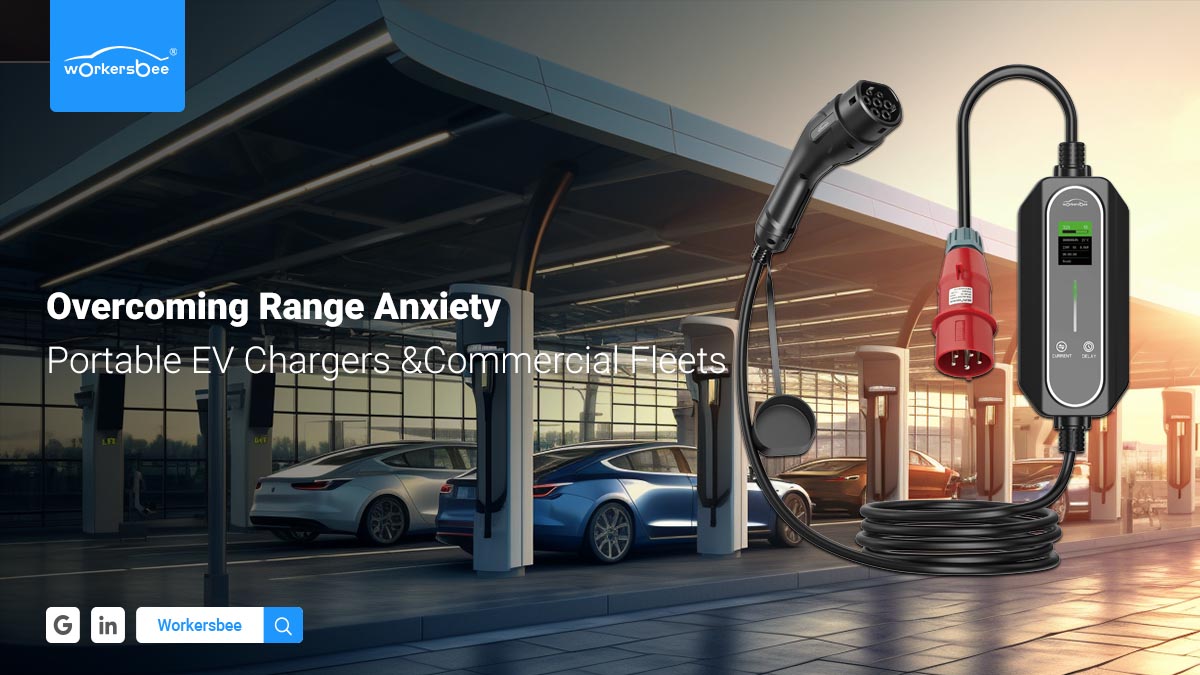
 How Portable Charging Helps Commercial Fleets Reduce Range-Related Risk
Mar 26, 2026
Range anxiety does not mean the same thing in a commercial fleet as it does for a private EV driver. In fleet operations, it is less about personal comfort and more about route confidence, vehicle readiness, service continuity, and the ability to keep daily schedules on track.
That is why portable EV charging should not be treated as a universal answer. For many fleets, depot charging remains the backbone, public charging fills access gaps, and portable charging adds flexibility where fixed infrastructure is limited, temporary, or not yet fully built out. The more useful question is not whether portable charging is helpful in general. It is where it reduces risk in a real fleet operation.
Why Range Anxiety Hits Fleets Differently
In a private EV, range anxiety is usually discussed as a driver concern. In a commercial fleet, it quickly becomes a business issue. A vehicle that returns late, misses a route, or cannot complete a planned shift affects more than one trip. It can disrupt dispatch decisions, reduce vehicle utilization, and create avoidable pressure across the whole operation.
Missed routes and service disruption are one part of the problem. If operators are not confident that vehicles can complete their daily duty cycles, route planning becomes more conservative. That often means shorter assignments, more buffer time, or less efficient use of assets. Over time, the issue is not just range. It is lower productivity.
Downtime risk is another layer. A fleet vehicle does not create value when it is waiting for an unplanned charge, searching for a workable charging point, or sitting idle because the available charging option does not fit the schedule. For delivery fleets, service fleets, or commercial vans with repeated daily usage, that kind of uncertainty matters far more than the consumer version of range anxiety.
Fleet range anxiety is an operations issue, not just a battery issue. It sits at the intersection of route design, duty cycle, charging access, site planning, and daily readiness. Once that is clear, the discussion becomes more practical: which charging setup reduces risk, and under what conditions?
Where Portable Charging Actually Fits
This topic often gets oversimplified because fleets rarely depend on a single charging path. Stronger charging strategies combine more than one option based on vehicle type, route pattern, dwell time, and site conditions.
For most commercial fleets, depot charging remains the core solution. It offers more control over charging windows, energy planning, and overnight readiness. Public charging can help where route coverage or off-site flexibility is needed, but it usually works best as part of a wider strategy rather than as the only plan.
Portable charging fits into a different role. It is most useful when a fleet needs flexibility that fixed infrastructure cannot yet provide. That may happen during early electrification, while a site is waiting for upgrades, when vehicles operate from temporary locations, or when backup charging is needed to reduce exposure to scheduling risk.
In those cases, portable charging is not replacing a full charging program. It is helping the fleet stay operational while infrastructure, usage, or deployment conditions are still evolving. That distinction matters. Portable charging is valuable when it solves a real operational gap. It becomes much less convincing when it is expected to function as the answer to every fleet charging challenge.
When Portable Charging Makes Sense
Portable charging becomes most useful when a fleet needs flexibility that fixed infrastructure cannot yet provide. In many operations, the real value is not maximum charging power. It is the ability to keep vehicles moving while the charging strategy is still evolving.
One clear use case is early electrification. A fleet may be adding EVs before depot charging is fully built out, or before service upgrades are complete. In that situation, portable charging can help bridge the gap. It does not remove the need for long-term infrastructure, but it can reduce pressure during the transition period and help the operation move forward before the final charging setup is fully in place.
Portable charging can also make sense when backup coverage is needed. Some fleets already have a base charging plan, but still face uncertainty around overflow demand, irregular routes, maintenance windows, or site access limitations. In those cases, portable charging adds resilience. Its value comes from reducing exposure to gaps in the charging plan rather than serving as the main system for every vehicle.
Another practical fit is for light-duty or mixed-use fleets with variable operating patterns. If a fleet includes service vehicles, regional support vehicles, or smaller mixed-duty assets that do not all return under the same conditions every day, portable charging may offer useful breathing room. The key is that the charging window, vehicle energy demand, and available power still have to match.
Temporary sites and changing work locations are another strong fit. This is especially relevant where vehicles operate from remote, temporary, or reconfigured sites that are difficult to justify for permanent charging construction. In those settings, permits, trenching, grid work, and long installation timelines can make fixed charging a poor first move. Portable charging gives operators a way to reduce delay without pretending that temporary infrastructure is the final answer.
Portable Charging Fit at a Glance
Fleet situation
Where portable charging helps
What it does not replace
Early EV rollout
Bridges the gap before depot charging is fully built
Permanent site infrastructure
Backup coverage needs
Adds resilience during overflow, irregular routes, or site limitations
A complete primary charging plan
Light-duty or mixed-use fleets
Supports variable daily use where flexibility matters
High-throughput charging for intensive operations
Temporary or changing sites
Reduces delay where fixed construction is hard to justify
Long-term scalable site planning
What Portable Charging Cannot Replace
Portable charging becomes much easier to evaluate when its limits are clear. It can add flexibility, reduce exposure to charging gaps, and support temporary or transitional needs. What it does not do well is replace every part of a mature fleet charging system.
It does not replace high-throughput depot charging. When a fleet depends on predictable overnight charging for many vehicles, or needs to manage multiple vehicles within fixed return windows, depot charging remains the backbone. That kind of charging depends on structured site-level planning, not just mobility.
It also does not replace fast turnaround where power demand is high. If the operation relies on quick vehicle turnaround, high daily utilization, or heavier-duty vehicle cycles, charging speed and power availability become much more important. In those conditions, portable charging may help at the edges, but it is unlikely to function as the central answer.
Portable charging is also not a substitute for long-term site planning. Once a fleet moves beyond pilot scale, issues such as load management, charger placement, utility coordination, maintenance workflow, and site expansion become harder to avoid. A charging approach that works for a small pilot or temporary site may not scale cleanly once more vehicles are added.
Portable charging is strongest when it fills a gap. It is much weaker when it is expected to carry the full weight of a fleet charging strategy that really needs permanent infrastructure, structured charging windows, and long-term operational control.
How to Evaluate a Portable Charging Solution
If portable charging is being considered, the first question should not be whether the equipment is technically portable. It should be whether the solution fits the fleet’s operating window, vehicle demand, and site constraints.
Power access comes first. A portable charging solution is only useful if the available power source is realistic for the vehicles and schedules involved. That means fleet operators need to look at plug compatibility, voltage, available circuits, and where charging will actually happen in daily operation. Flexibility on paper does not help much if usable power is inconsistent at the real site.
Charging speed also has to match the operating window. A portable charging unit may be valuable for overnight top-ups, standby vehicles, or low-urgency charging, but much less useful if the vehicle needs to return to service quickly. This is where many purchasing decisions go wrong. The device may work technically, but not operationally. The real question is whether that charge rate fits the time the vehicle is actually available.
Mobility and handling matter more than they seem. If equipment is moved between sites, vehicles, or work areas, storage, cable handling, weight, environmental exposure, and day-to-day usability all become part of the decision. A fleet solution that is difficult to move, protect, or deploy consistently can create friction instead of flexibility.
Durability and support should also be evaluated early. Commercial use creates different expectations from private or occasional charging. Fleets need equipment that can tolerate repeated handling, consistent operation, and real-world environmental conditions. Support, replacement availability, and service response all matter because a portable charging tool used as a backup or operational buffer still needs to be dependable when the fleet actually needs it.
What a Practical Fleet Charging Mix Looks Like
The most resilient fleet charging strategies usually do not rely on a single charging path. They build around a base layer and then add flexibility where the operation needs it most.
For many fleets, the base layer is depot charging. It gives operators more control over overnight charging, vehicle readiness, and routine energy planning. On top of that, public charging can provide route support when vehicles move outside the normal site pattern or when additional coverage is needed.
Portable charging fits best as a flexible layer. It can help during early electrification, during site upgrades, at temporary locations, or when backup charging is needed to reduce operational exposure. Its strongest value is not that it replaces structured infrastructure. It is that it adds resilience when the charging plan cannot rely on fixed charging alone.
That is the more useful way to think about portable charging in fleet operations. Not as a complete charging strategy by itself, but as one part of a broader approach designed around uptime, flexibility, and deployment reality.
What Fleet Operators Should Keep in Mind
Portable EV charging can help commercial fleets reduce range-related risk, but only when it is matched to the right use case. It is most useful where flexibility, backup coverage, temporary deployment, or transitional support matter more than maximum throughput.
For most fleets, that means portable charging works best as part of a wider charging mix rather than as a substitute for depot infrastructure or long-term site planning. The fleets that get the most value from it are usually the ones that understand both its strengths and its limits before deployment begins.
For businesses moving from planning to deployment, it helps to work with suppliers that understand both hardware fit and real operational requirements. Workersbee supports commercial EV charging projects with charging connectors, portable charging solutions, and related supply capabilities designed for practical deployment needs.
Read More



 Contact Us


 English


 IPv6 network supported