Home

AC vs DC charging

  • How EV Charging Stations Actually Work How EV Charging Stations Actually Work
    Nov 13, 2025
    EV charging stations coordinate three flows—power, low-voltage cable signaling, and cloud data—so the vehicle and station agree on limits, close the contactors safely, deliver measured energy, and settle the session.     First-time user quick pathLocate a station → authenticate (RFID, app, or Plug and Charge) → plug in and watch the session start.     What a station actually doesA station is more than a socket. It routes safe power, exchanges low-voltage signals with the car to agree limits, talks to a backend to authorize and log the session, and produces a billable record. The process is controlled, measured, and auditable end to end.     The three flows in one viewPower: grid or on-site generation → distribution panel → cabinet or wallbox → contactor → vehicle batteryControl: control-pilot signaling (IEC 61851-1 / SAE J1772) advertises limits → vehicle requests within those limits → safe state reachedData: station ↔ cloud via a charging protocol (e.g., OCPP) for authorization, tariffs, session status, meter values, and receipt     AC vs DCWith AC charging, AC-to-DC conversion happens inside the car’s onboard charger (OBC) at modest power.With DC fast charging, conversion moves into the cabinet; rectifier modules supply high-current DC directly to the battery while the vehicle supervises demand and limits.     AC vs DC roles and signals Item AC charging (home & workplace) DC fast charging (public DC) Where AC→DC happens Inside the car (onboard charger) Inside the cabinet (rectifier modules) Typical power 3.7–22 kW 50–400 kW+ How current is set Vehicle requests within station limit Station modules meet vehicle request within site and thermal limits Bottleneck rule Session rate = min(vehicle capability, station capability, site limits) Session rate = min(vehicle capability, station capability, site limits) Cable and interface (by region) Type 2 or J1772 CCS2, CCS1, GB/T, or NACS On-cable signaling Control Pilot 1 kHz PWM declares current ceiling; Proximity Pilot identifies cable and latch Same low-voltage chain plus high-voltage interlocks and insulation checks Safety chain State transitions before the main contactor closes; leakage protection present Same chain plus pack-level protections Cloud link Session, tariff, status, faults, firmware Same, with more telemetry and thermal data     What happens on the wireBefore any high voltage appears, the station and vehicle talk over two low-voltage lines in the connector. The control pilot is a 1 kHz square wave; its duty cycle advertises the station’s current ceiling. The vehicle reads that ceiling and never requests more.   The proximity pilot tells the station what cable is connected and whether the latch is engaged. Only after these checks pass does the system move from a waiting state to an energized state. For readers who need the physical interface and handling notes, see our Type 2 EV connector page for shell geometry, latch behavior, and cable rating basics.     The safety chain that prevents hot-plugging Mechanical: the latch holds the plug in place; the station senses it. Electrical: ground and insulation checks pass; leakage protection is armed. Logical: once the vehicle signals readiness, the station transitions to the energized state. Power: the main contactor (high-power relay) closes; monitoring continues during the session. If any condition fails, the contactor opens and power stops.     How the station talks to the cloudStations rarely run alone. Through OCPP (Open Charge Point Protocol), the unit reports status, receives tariffs and updates, opens and closes sessions, and uploads meter values and error codes. Typical message flow includes Authorize → StartTransaction → MeterValues (periodic) → StopTransaction, plus Heartbeat and Firmware management. A certified meter records energy in kilowatt-hours; time-based or session fees can be added by policy, but the energy measure anchors the bill.     From plug-in to billing: a seven-step timeline 1. Physical connection: insert the connector until the latch clicks; the station senses cable type and capacity. 2. Safety checks: ground and insulation look correct; the station broadcasts the 1 kHz control signal. 3. Capability announcement: the duty cycle states the maximum allowed current for this outlet and cable. 4. Vehicle readiness: the vehicle acknowledges and requests an appropriate current or begins the DC handshake. 5. Energize: the station closes contactors; protective devices arm and stay vigilant. 6. Metered delivery: energy is measured and logged; limits adjust with temperature, load management, or site policy. 7. End and settle: stop via button, app, RFID, or target reached; logs are finalized for billing.     Why sessions fail more often than they should• Physical fit and latch: dirt, misalignment, worn seals, or a bent spring can block the proximity signal.• Cable and strain relief: sharp bends, damaged sheath, or water ingress trigger protection.• Signaling out of range: poor contact or corrosion alters low-voltage levels so the vehicle never sees a valid state.• Backend delays: if the cloud takes too long to authorize, the station times out.• Thermal limits: hot weather or a dusty filter derates current; some vehicles stop early to protect the pack. For high-duty public sites in hot weather, a CCS2 liquid-cooled connector helps keep handle temperatures stable and cable weight manageable during long sessions.     GlossaryContactor: high-power relay that connects the main circuitDuty cycle: percentage of time the control signal is on within one cycleInsulation check: verification that high-voltage parts are not leaking to groundPlug and Charge (ISO 15118): certificate-based automatic authentication over the same cable     FAQs Can I just plug in and start?Some vehicles support Plug and Charge (ISO 15118) for certificate-based automatic authentication. Otherwise use RFID or the operator’s app.   Why did my session fail to start?Press until the latch clicks, check the cable route (no sharp bends), clean visible dirt on the connector, then try the app if RFID times out.   Why does charging sometimes slow down?Stations and vehicles reduce current near high state-of-charge, when the connector warms up, or when the site balances power across stalls.   What exactly is being billed?Energy in kilowatt-hours forms the base. Operators may add time-based or session fees and taxes; the receipt lists the components.
    Read More

  • Are EV Chargers Universal in 2026? A Practical Compatibility Check from Workersbee Are EV Chargers Universal in 2026? A Practical Compatibility Check from Workersbee
    Nov 12, 2025
    Short answer EV chargers are not fully universal. AC charging is often compatible within the same region when the plug matches your car inlet or you use an approved adapter. DC fast charging varies more. It depends on the connector family, the charging site hardware, and what your vehicle supports.     30-second compatibility check 1. Identify your vehicle inlet, the socket on the car. 2. Confirm your region’s common plug families. 3. Decide where you charge most: home or work versus public fast charging. 4. Match the connector. If you need an adapter, verify ratings and site support before you rely on it.     Three reasons compatibility fails Most people mean one of these three things when they ask if chargers are universal: · Physical fit: the plug must latch correctly into the inlet. · Electrical capability: the car and equipment must carry the current safely for long sessions. · Site access: the charging network must allow the session with your vehicle and adapter setup.   If any one of these fails, charging will feel non-universal even if the plug looks close.     Charging levels that affect compatibility · Level 1: uses a standard outlet. It is slow and best for low daily mileage or overnight top-ups. · Level 2: uses a dedicated circuit. It is the daily solution for home and workplace charging. · DC fast charging: feeds the battery directly and is mainly for quick turnarounds and travel.   If you want a deeper breakdown of home and public scenarios, see EV Charging Levels Explained: Level 1, Level 2 and DC Fast Charging.   Two limits matter more than the charger label. Your on-board charger sets your maximum AC charging speed, and a bigger wallbox cannot bypass that. If AC speed feels lower than expected, What is an on-board charger and why it limits AC speed will usually explain the gap. DC speed is shaped by the battery and thermal system. Power often tapers as the battery fills, and it can drop if the pack is cold or hot.     Compatibility by region North America Most non-Tesla vehicles use J1772 for AC and CCS1 for DC. NACS is increasingly common on newer vehicles and across many public networks. During the transition, some sites support multiple plugs, but reliability and access rules can differ by location. If you are navigating mixed infrastructure, NACS vs CCS: access and reliability can help you plan with fewer surprises.   Europe and Type 2 regions Type 2 is common for AC. CCS2 is the mainstream for DC fast charging on newer vehicles. Some AC posts are socketed and require you to bring a cable. Others are tethered and provide the cable.   China China mainly uses GB/T for both AC and DC. A GB/T vehicle will not directly plug into CCS or NACS infrastructure without purpose-built hardware and clear support on both the vehicle side and the station side. For cross-region operations, it is usually safer to standardize fleets and charging hardware within each region rather than depend on cross-standard adapters.   Japan and legacy segments CHAdeMO still exists in some areas and on older vehicles. It is less common on newer models in many markets. Treat it as a legacy factor and plan routes around real site availability.   If you want a connector-by-connector reference across regions, EV connector types field guide is the better place for the full breakdown.     When adapters make sense Adapters can solve transition gaps, especially when your region is mid-change or when you charge occasionally in a different ecosystem. If you rely on DC fast charging frequently, a native connector family is the safer long-term path.     Adapter red-line checklist Use this checklist before you buy or deploy an adapter: · Continuous current rating matters more than peak claims. · Locking and interlock must stay secure under vibration and normal handling. · Temperature protection matters for long sessions, and overheating is a common failure mode. · Sealing and strain relief reduce failures from water ingress and bending at the cable exit. · Support policy matters, and some vehicles or networks restrict adapter use even if it physically fits.   If you manage multiple vehicles, standardize one approved adapter model per use case. Document where it is allowed and train drivers on handling.     Quick decision table Region Vehicle inlet on the car Most common AC plug Most common DC plug Usually works without adapters Double-check before relying on it North America J1772 + CCS1 J1772 CCS1 AC on J1772, DC on CCS1 If using NACS sites via adapter, confirm site support and adapter specs. North America NACS NACS NACS AC and DC on NACS sites that support your vehicle If using CCS1 sites via adapter, check latch fit, current rating, and cable strain relief. Europe and Type 2 regions Type 2 + CCS2 Type 2 CCS2 AC on Type 2, DC on CCS2 If the post is socketed, you may need to bring a compatible Type 2 cable. China GB/T (AC and DC) GB/T AC GB/T DC AC and DC within GB/T infrastructure Cross-region use typically needs dedicated solutions, not casual adapters. Cross-region travel or fleets Varies Varies Varies Best when vehicles and infrastructure are standardized per region Do not assume cross-standard DC is allowed or safe; verify policies, ratings, and training.     Home vs public charging: what to check Home charging is about consistency and safety. A stable Level 2 setup that matches panel capacity and daily mileage usually wins over chasing maximum power.   Public charging is about planning. Check plug availability on your frequent routes and keep one realistic fallback option.     Installation checks for home and workplace · Use a dedicated circuit sized for continuous load. · Match the plug and outlet type to your region and enclosure needs. · Choose a cable length that reaches comfortably without tight bends or pulling on the connector. · Avoid sharp bends near the handle and near the wallbox or outlet. · Have a licensed electrician confirm panel capacity, protection devices, routing, and local code requirements.   For a more detailed planning checklist, Charging an Electric Car at Home: complete guide covers the common pitfalls.   If you want a portable approach for travel, rentals, or temporary sites, a Portable EV Charger with adjustable current can help you charge safely while you finalize a permanent installation.     Why charging speed changes Charging power is rarely flat. DC fast charging often peaks in a middle range and tapers as the battery fills. Cold weather can reduce speed until the pack warms. Hot weather can trigger thermal limits.   For predictable travel, many drivers get better overall time by charging in the middle band rather than pushing to full at every stop. Treat 10–80% as a rule of thumb, not a guarantee.     FAQ Are Level 2 chargers universal for most cars? Mostly within each region. If the connector matches your inlet, Level 2 charging works well. Your on-board charger usually sets the AC speed ceiling.   Do DC fast chargers work with every EV? No. DC compatibility depends on the connector family and what the site supports. Always confirm the plug type and access rules before a trip, especially during connector transitions.   Do I need an adapter for NACS sites? It depends on your inlet and the charging site. Some vehicles can use certified adapters where network and vehicle support are in place. If you charge frequently on DC, prefer a native connector family when possible.   Why does my charging speed change from day to day? Battery temperature, state of charge, station capability, and your vehicle limits all matter. AC speed is capped by the on-board charger. DC speed is shaped by battery and thermal management.     What Workersbee can help with For reliable daily charging, focus on connector durability, sealing, and strain relief, not just nameplate power. Workersbee designs EV Connectors for real handling and long service life across common regional standards.   For temporary sites and travel, a current-adjustable Portable EV Charger can help you charge safely while you finalize a permanent installation.
    Read More
  • Type 1 vs Type 2 EV Charger Differences: What to Choose and Why (US & EU) Type 1 vs Type 2 EV Charger Differences: What to Choose and Why (US & EU)

    Oct 21, 2025
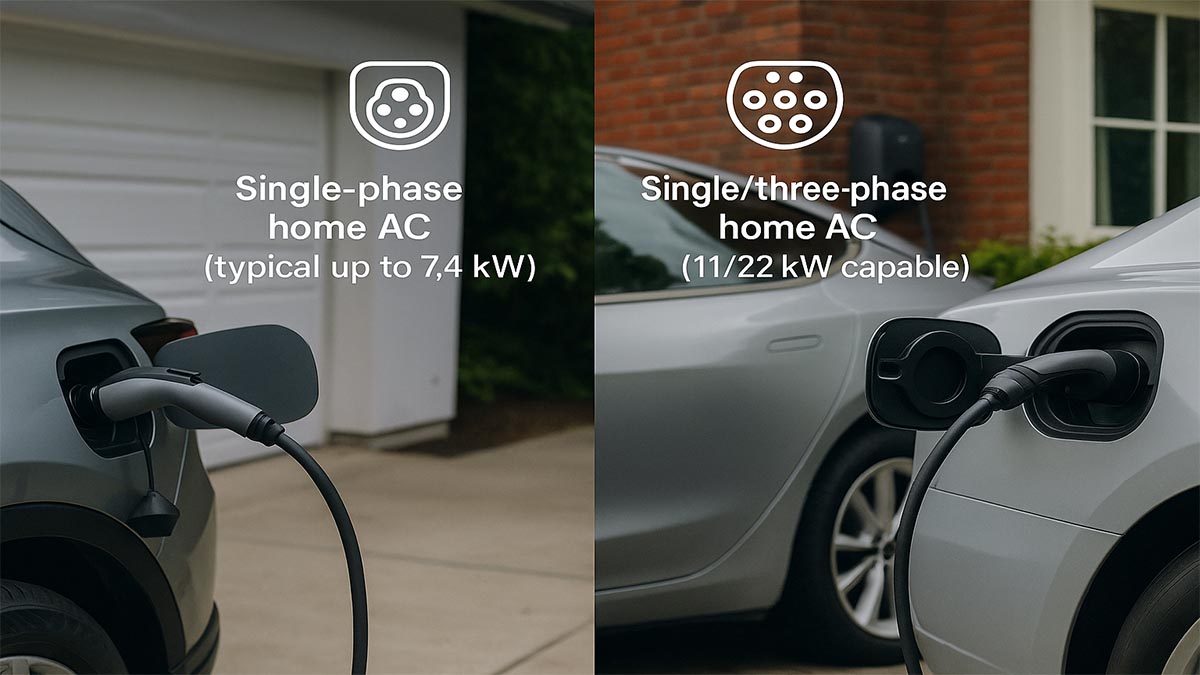
    Type 1 (often called J1772) uses a 5-pin single-phase AC connector. Typical home charging tops out around 32 A ≈ 7.4 kW. It’s the norm in North America and used on many Japanese imports. Type 2 uses a 7-pin connector that supports single- and three-phase AC. Home wallboxes commonly deliver 11 kW (3-phase 16 A) or 22 kW (3-phase 32 A). It’s standard across Europe and adopted in many other regions.     One-screen comparison table Item Type 1 Type 2 Pins 5 7 Phase Single-phase Single- or three-phase Typical home charge rate (kW) Up to ~7.4 kW (32 A) 7.4 kW single-phase; 11/22 kW on 3-phase Locking / anti-unplug Latch on the handle Vehicle/charger side lock-pin common Regions North America, parts of Asia Europe, UK, many global markets Common use cases US/CA homes, workplace L2 EU homes and public AC posts     Regions and vehiclesIn North America, most AC charging hardware and vehicles use Type 1. In Europe and the UK, Type 2 is universal for AC at home and in public. If you own an imported vehicle with the “other” inlet, you can often bridge the gap with an adapter, but long-term convenience and reliability are best when your vehicle inlet, home charger, and local infrastructure match the local standard.     Power and wiring basicsSingle-phase 32 A ≈ 7.4 kWThree-phase 16/32 A ≈ 11/22 kW   What that means: with a mid-size EV battery, 7.4 kW typically restores a solid daily commute overnight. Three-phase 11/22 kW shortens dwell time and suits driveways with multiple users or business car parks—but only if the property has three-phase supply and the vehicle’s onboard charger supports those rates.   Tethered vs socket (plug-in) home chargersTethered units have a permanently attached cable. They’re quick to use, encourage correct cable management, and reduce wear on the vehicle inlet. Socketed units accept any compatible cable: they look cleaner on the wall, give you flexibility if you switch vehicles or regions, and let you choose cable length—but you’ll handle the cable each session. Where parking spaces are shared, tethered keeps workflows simple; in mixed fleets or rental apartments, socketed preserves flexibility.     Adapters and compatibilityType 1 ↔ Type 2 adapters exist and work in many everyday cases. Treat them as a bridge, not a strategy. Check current ratings, temperature derating, and whether your vehicle and charger support the same control protocols.   For regular use at a fixed location, aligning the charger with the local standard is the better long-term move. For travel or short-term accommodation, an adapter can be practical as long as you follow the current limits of the weakest component.     AC vs DCType 1 and Type 2 describe AC plugs. CCS1 and CCS2 describe combined systems that add two DC pins beneath the AC section for fast charging. Your AC choice determines home and workplace charging convenience; your DC fast-charging experience depends on the CCS standard in your region and your car’s DC capability. Don’t assume a Type 2 car can fast-charge everywhere in Europe without checking CCS2 support, and likewise for Type 1/CCS1 in North America.     Quick decision flow Region: US/CA/JP → usually Type 1; EU/UK → Type 2   Supply: Do you have single-phase only, or is three-phase available and approved?   Vehicle: What inlet do you have, and what onboard AC power can it accept (e.g., 7.4, 11, or 22 kW)?   Usage plan: Daily overnight at home, or many short sessions with multiple users? Result: Match the plug to the region and vehicle; size the charger to your panel and use pattern; consider an adapter only for edge cases.     For businesses and small sitesIf you serve mixed vehicles, Type 2 sockets (with separate cables) are common across Europe and simplify cable replacement. In North America, dedicated Type 1 tethered posts keep sessions fast and intuitive for staff and visitors. In shared lots, clear signage, cable holsters, and basic training reduce mis-plugs and downtime.     FAQsQ: I have a Type 1 car in Europe. Can I install a Type 2 wallbox at home?A: Yes, but you’ll need an appropriate Type 2-to-Type 1 cable or adapter. For everyday use, consider aligning vehicle and charger on your next upgrade to reduce friction.   Q: Is upgrading to three-phase 22 kW worth it?A: Only if your property has three-phase supply and your car can accept 22 kW AC. Many drivers find 11 kW already more than enough; 22 kW shines for multi-user sites or short dwell patterns.   Q: Do adapters affect safety or warranty?A: Use certified adapters within their current rating and keep connections fully seated and dry. Follow the vehicle and charger manuals; misuse can void warranties.   Q: Which is better for shared parking: tethered or socketed?A: Tethered is faster for casual users and reduces incorrect cable choices. Socketed is more flexible across vehicle types and easier to maintain when cables wear out.   Meet Workersbee’s Portable EV Chargers: Sae j1772 flex charger2portable EV charger type 2 IEC 62196 3-Phase Type 2 EVSE Portable EV Charger
    Read More

Need Help? leave a message

Leave A Message
Submit

home

products

whatsApp

contact